Introduction
Most golf cart display evaluations begin with specifications such as screen size, Apple CarPlay, Android Auto, and touchscreen functionality. While these features are easy to compare, they reveal very little about how well a display performs once it becomes part of a production vehicle.
For golf cart manufacturers and low speed vehicle (LSV) builders, the more important consideration is integration. As displays become increasingly central to the driving experience, manufacturers are placing greater emphasis on how a display interacts with vehicle systems, presents vehicle data, and functions as part of the overall vehicle platform rather than evaluating it solely on its feature list.
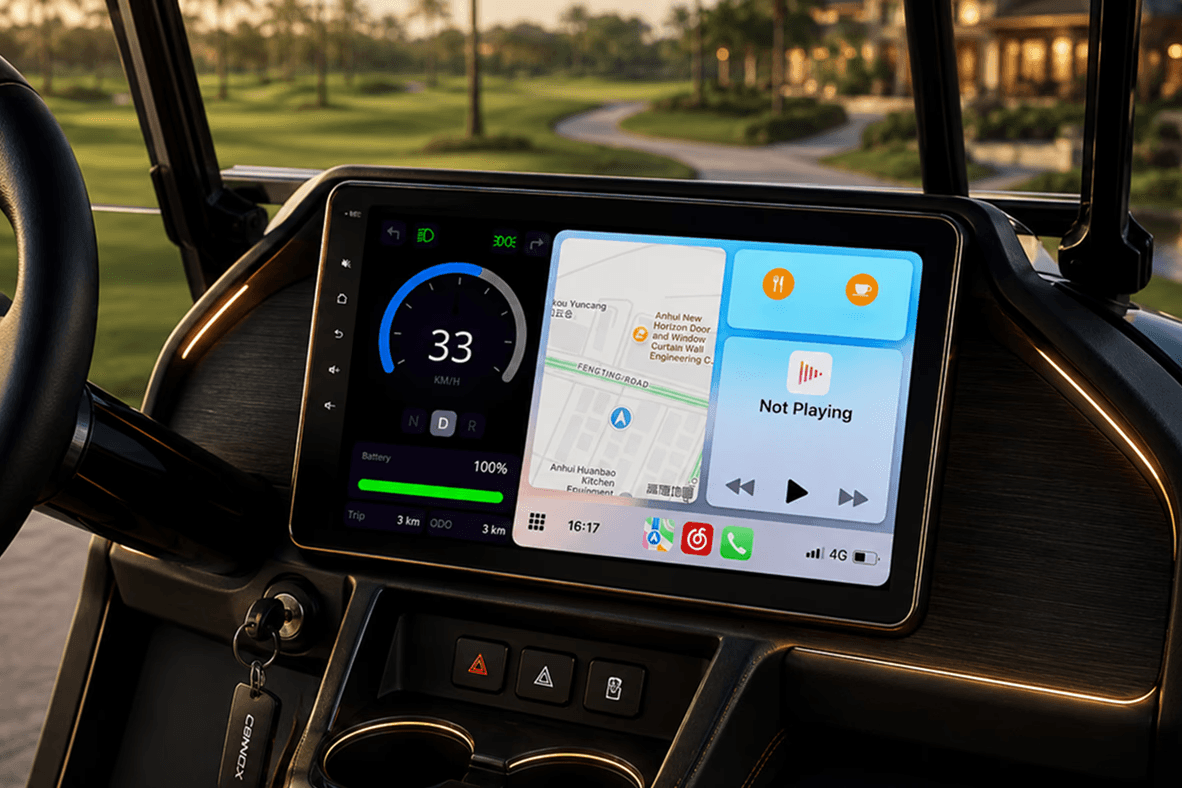
What Manufacturers Mean When They Ask for an Integrated Golf Cart Display?
When manufacturers search for:
- Integrated golf cart display
- OEM golf cart display
- Golf cart display supplier
- LSV display solution
They’re evaluating whether the display can become part of the vehicle platform. An integrated display typically needs to support:
- Vehicle dashboard information
- Battery visibility
- Gear indication
- Reverse camera functionality
- Connectivity features
- Vehicle communication
- Production deployment
The goal is to create a single interface that feels native to the vehicle rather than added afterwards.
Why Integration Matters More Than Features?
| Capability | Typical Display Solution | Integrated Display Solution |
|---|---|---|
| Vehicle Data | Display functionality often operates independently from vehicle systems. | Real-time dashboard with speed, gear position, battery %, trip distance, and odometer. |
| Vehicle Communication | Limited vehicle data integration. | CAN bus enabled vehicle data integration |
| Reverse Camera | Camera implementation varies by system. | Included rear view camera that auto-activates on reverse |
| Smartphone Connectivity | Connectivity features available on some systems | Wireless Apple CarPlay and Android Auto |
| Audio & Calling | Basic connectivity capabilities | Bluetooth audio and hands-free calling |
Looking Beyond the Screen
The golf cart display market is evolving, and manufacturers are no longer evaluating displays solely as infotainment systems. Increasingly, displays are being assessed as part of the overall vehicle platform and the role they play in the driving experience.
The most effective display solutions bring together real-time dashboard information, vehicle communication, connectivity, and camera functionality through a single interface. As customer expectations continue to evolve, integration is becoming just as important as the feature set itself.
For manufacturers building modern golf carts and LSVs, the conversation is shifting from individual specifications to overall vehicle experience. The question is no longer whether a display includes the required features, but whether it can function as a seamless part of the vehicle. Ultimately, that’s what separates a display that is simply installed from one that is truly integrated.
