Introduction
A larger solar panel can produce more energy. It also takes up more room, adds more weight and places greater demands on the structure beneath it. That trade-off is easy to manage on a house roof. On a golf cart or low-speed vehicle (LSV), it can decide whether a solar installation is practical at all.
For mobility applications, panel selection should begin with the available mounting envelope and the vehicle’s daily energy use, not the highest wattage on a specification sheet. Residential projects work in almost the opposite direction: roof area, total system capacity and installation economics tend to reward larger modules.
The short answer: 200W and 300W panels are often easier to package on compact vehicles; 400W panels may suit larger roofs or purpose-built canopies; 530W and 650W modules are generally better suited to fixed residential, commercial or ground-mounted installations. The final choice still depends on physical dimensions, weight, shading, electrical compatibility and real operating conditions.
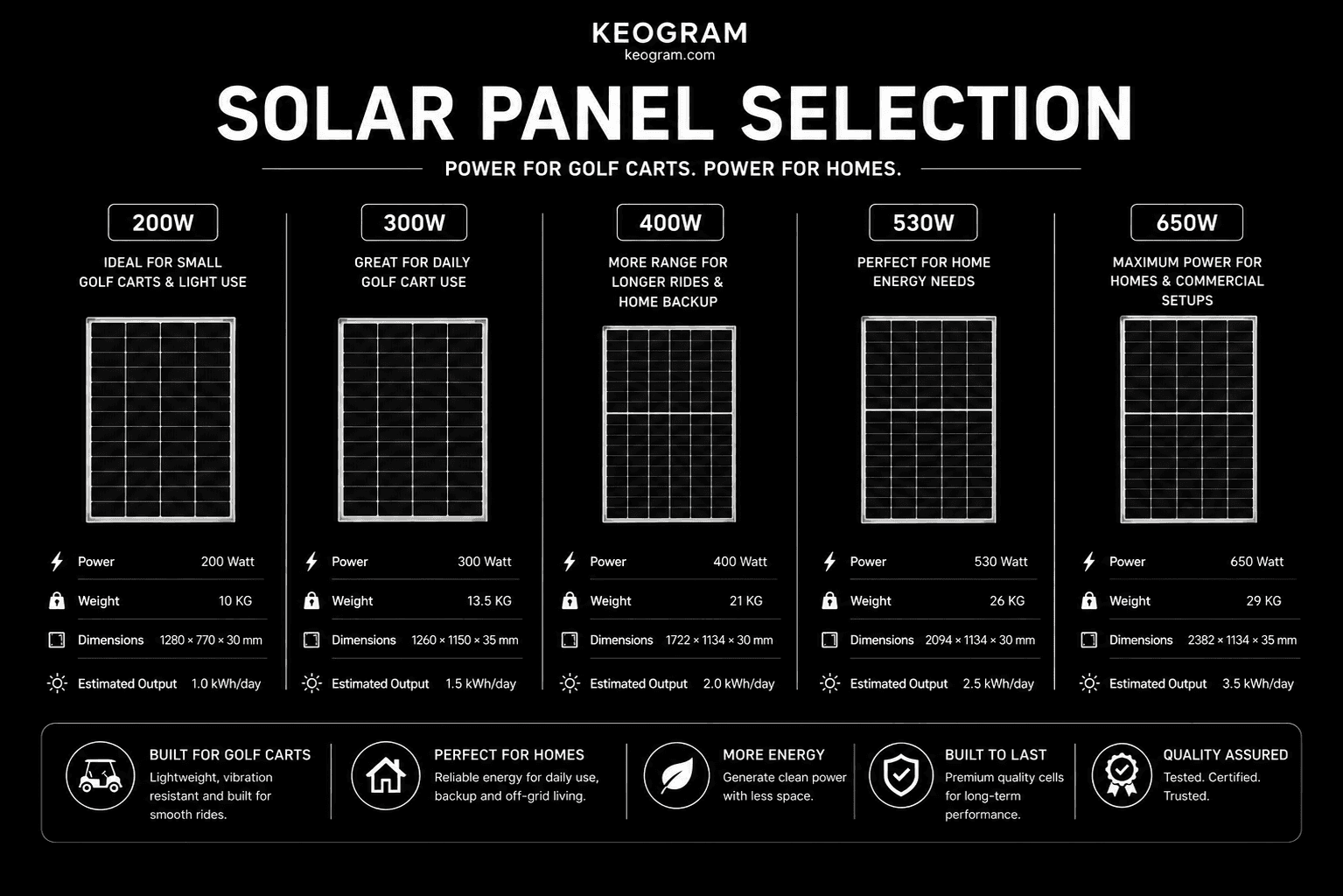
Panel wattage rises with physical size and weight. The best module is the one that fits the application, not simply the one with the largest number.
Solar panel sizes at a glance
| Rated power | Dimensions | Weight | Energy / day | Practical starting point |
|---|---|---|---|---|
| 200W | 1,280 × 770 × 30 mm | 10 kg | 1.0 kWh | Compact mobility roofs and small off-grid loads |
| 300W | 1,260 × 1,150 × 35 mm | 13.5 kg | 1.5 kWh | Larger carts, LSVs and small stationary systems |
| 400W | 1,722 × 1,134 × 30 mm | 21 kg | 2.0 kWh | Large vehicle canopies and residential roofs |
| 530W | 2,094 × 1,134 × 30 mm | 26 kg | 2.5 kWh | Residential, commercial and fixed structures |
| 650W | 2,382 × 1,134 × 35 mm | 29 kg | 3.5 kWh | Commercial roofs and ground-mounted systems |
The table also exposes a common mistake: comparing panels only by wattage. A 650W module is not automatically “better” than a 300W module. At roughly 2.38 metres long and 29 kilograms, it may simply be too large for a vehicle roof, even before mounting hardware, wind loading and vibration are considered.
What size solar panel works for a golf cart or LSV?
For a golf cart or LSV, a 200W to 400W panel is the most plausible starting range, subject to the vehicle’s roof dimensions and load limits. Compact 200W modules are easier to package. A 300W panel can offer more useful daily generation without moving immediately into the size and mass of a full residential module. A 400W panel may work where the vehicle has a large canopy or a roof designed around the solar installation.
Start with five checks.
1. Measure the usable roof, not the overall roof
Lights, roof rails, antennas, drainage paths and curved edges all reduce the real mounting area. Keep space for brackets, cable routing and service access. Overhang should be treated cautiously because it can increase wind loading and create a hazard around the vehicle.
2. Account for panel and mounting weight
The module is only part of the installed mass. Rails, brackets, fasteners, wiring and the charging electronics add weight too. That load sits high on the vehicle, so the roof structure and vehicle manufacturer’s limits matter.
3. Estimate the energy, not just the watts
Panel wattage is a laboratory rating. Daily energy is the more useful number.
A simple early estimate is:
Daily energy (kWh) ≈ panel power (kW) × peak-sun-hours × system efficiency
For example, a 300W panel receiving five peak-sun-hours has a theoretical yield of 1.5 kWh. After heat, conversion, wiring and other losses, usable energy will be lower. Shade from buildings or trees can reduce it further and vehicles rarely remain parked at the perfect solar angle all day.
4. Design for a moving environment
A home panel stays put. A vehicle panel experiences vibration, repeated shock, road debris, washing, weather and changing airflow. Mounting hardware, cable strain relief, connector placement and environmental sealing deserve the same attention as the module rating.
The goal is not to turn the roof into a miniature power station. It is to recover useful energy during operation and parking without compromising the vehicle around it.
5. Match the panel to the charging system
The panel’s open-circuit voltage, operating voltage and current must sit within the limits of the solar charge controller. The controller must also suit the vehicle battery chemistry and pack voltage. A mobility system may need to support common vehicle architectures rather than a single household inverter voltage.
This is where an integrated system matters. Selecting a panel is only one part of the job; the charger, cabling and battery interface still need to work as one dependable system.
Keogram’s complete solar charger kit for golf carts and LSVs
The Keogram Solar Charger is available as a complete, ready-to-install kit for OEM and factory integration. It brings the three essential parts together:
- Solar panel
- Solar charger
- Integration cabling
Supplying these components as one kit reduces the engineering and sourcing work involved in pairing separate products. It also gives manufacturers and fleet programs a unified starting point for vehicle installation, testing and production deployment.
The current Keogram system is built around a 500W solar charging output and a panel measuring approximately 1.2 × 0.7 metres. Its charger accepts an 18-50V solar input and supports 48V, 60V and 72V vehicle battery systems, covering several battery architectures used in golf carts and low-speed vehicles.
| Keogram Solar Charger specification | Published value |
|---|---|
| Kit contents | Solar panel, charger and cabling |
| Solar charging output | 500W |
| Panel size | 1.2 × 0.7 m |
| Solar input voltage | 18-50V |
| Supported vehicle battery systems | 48V, 60V and 72V |
| Installation | OEM integrated / factory installed |
| Published daily range extension | Approximately 3-13 miles (5-20 km) |
| Published maximum range extension | Up to 19 miles (30 km) in optimal conditions |
Keogram also offers “flexible panel options” to accommodate different roof structures, layouts and vehicle designs. That matters because mobility projects rarely share one universal roof envelope. The panel and integration approach can be adapted while preserving a clean, factory-installed result.
What the complete kit changes for an OEM?
A panel-only purchase leaves several questions open: Which charger should be used? Is its input window correct? How should it connect to the vehicle pack? Which cables and connectors are required? A complete kit narrows those gaps by providing the core components as a coordinated package.
For vehicle manufacturers and fleet operators, that can mean:
- Fewer separately sourced components
- A clearer path from prototype to factory installation
- Compatibility with multiple common battery voltages
- Solar charging whenever the vehicle is parked in usable daylight
- Less dependence on plug-in charging during the operating day
- Potentially longer daily operating range and reduced charging downtime
The system is intended to supplement normal charging rather than make sunlight the only energy source. The real range contribution will vary with weather, season, shade, vehicle efficiency, route, battery state and time outdoors. Keogram publishes an estimated 5–20 km of additional daily range, with up to 30 km under optimal conditions.
Manufacturers evaluating the kit can contact Keogram with their vehicle roof dimensions, battery voltage and expected duty cycle.
What size panel makes sense for a house?
Residential systems have different priorities. A house roof can usually carry multiple modules, and the installation is judged by total annual energy production, usable roof area, inverter design, local rules and installed cost.
For many homes, 400W to 530W modules provide a practical balance between power and module count.
A 650W panel can reduce the number of modules needed for a given system rating, but its physical size may make roof handling, layout and setbacks more difficult. Large-format modules are often more comfortable on commercial roofs or ground-mount frames.
Consider a simplified 6 kW target:
- 30 × 200W panels = 6 kW
- 20 × 300W panels = 6 kW
- 15 × 400W panels = 6 kW
- About 12 × 530W panels = 6.36 kW
- About 10 × 650W panels = 6.5 kW
Fewer modules can mean fewer clamps and electrical connections, but panel count is not the whole cost equation. Roof geometry, labour, inverter limits, fire setbacks and local availability may make a smaller module the better fit.
For a location-specific production estimate, tools such as NREL’s PVWatts Calculator are more useful than a single global “kWh per day” figure.
200W vs 400W solar panel: which is better?
Choose a 200W panel when space, handling weight and flexible placement are more important than maximum output from one module. It is a sensible class for compact mobility roofs, sheds and small off-grid systems.
Choose a 400W panel when the mounting surface can accept a full-size module and you want more generation with fewer panels. This class is common in residential planning and can also work on larger mobility platforms designed for it.
The power rating doubles, but the engineering decision is not twice as simple. On a vehicle, the jump from the example 200W module to the 400W module adds 11 kg and substantially increases the panel footprint. On a fixed roof, that larger footprint is often easier to accommodate.
A practical selection checklist
Before specifying a solar panel for a vehicle or building, confirm:
- Usable mounting dimensions, including edge clearances
- Total installed weight, not panel weight alone
- Expected local solar resource by season
- Partial shading during normal use
- Panel voltage and current across temperature extremes
- Charge controller or inverter compatibility
- Battery chemistry and nominal voltage
- Structural, wind and vibration requirements
- Cable routing, sealing and service access
- Applicable electrical, building and vehicle standards
A good design survives the less glamorous questions. Where does the cable enter? Can a technician replace the controller? What happens when half the panel is shaded? Will the mounting points remain secure after thousands of kilometres? Those details separate an attractive prototype from a reliable product.
The right panel starts with the application
For mobility, solar panel selection is a packaging and systems-engineering problem. A 200W or 300W module may produce less energy than a large residential panel, yet deliver the better product because it fits the roof, respects weight limits and works with the vehicle’s electrical architecture.
For homes and fixed installations, larger 400W, 530W or 650W modules can reduce panel count and make better use of an open roof or ground-mount area. Even then, the best answer comes from a site-specific layout not wattage alone.
Keogram develops hardware for real operating environments, including a complete solar charging kit for golf carts and low-speed vehicles. The kit includes the panel, 500W charger and cabling, with support for 48V, 60V and 72V battery systems and flexible panel options for different vehicle designs. If you are evaluating solar charging for an OEM mobility platform, contact Keogram to discuss roof packaging, battery voltage and production integration.
Frequently asked questions
How much energy does a 300W solar panel produce per day?
At five peak-sun-hours, a 300W panel has a theoretical output of about 1.5 kWh per day. Real output is lower after temperature, conversion, wiring, shading and dirt losses. Location and season can change the result substantially.
Can a solar panel charge a golf cart while it is parked?
Yes, if the panel, charge controller and battery pack are electrically compatible. The panel can generate energy whenever suitable sunlight is available. Charging rate depends on irradiance, panel size, shading, battery state and system efficiency.
Is a 650W solar panel suitable for a golf cart?
Usually not for a conventional cart roof. The example 650W module is approximately 2,382 × 1,134 mm and weighs 29 kg before mounting hardware. It is more naturally suited to fixed commercial or ground-mounted systems unless a vehicle has been specifically engineered around it.
What comes in the Keogram Solar Charger kit?
The complete kit includes a solar panel, 500W solar charger and integration cabling. It is designed for OEM or factory installation on golf carts and low-speed vehicles and supports 48V, 60V and 72V battery systems.
How much extra range can the Keogram Solar Charger provide?
Keogram publishes an estimated daily range extension of approximately 3–13 miles (5–20 km), with up to 19 miles (30 km) under optimal conditions. Actual results depend on sunlight, shade, vehicle efficiency, battery condition, route and operating pattern.
Does a higher-wattage panel always produce more energy?
Under the same test and operating conditions, a higher-rated panel can produce more power. In practice, poor orientation, heat or partial shade may allow a smaller, better-positioned panel to outperform a larger one at certain times.
What is the best solar panel size for an LSV?
There is no universal size, but 200W to 400W is a useful evaluation range for many LSV roof formats. The correct choice depends on roof area, weight limits, battery voltage, daily energy demand and the charge controller’s input range.
